P.O Box 01, Nakasongola - Uganda| Tel: 0392 797699 | E-mail: [email protected]

Latest News
Welcome to Nakasongola District
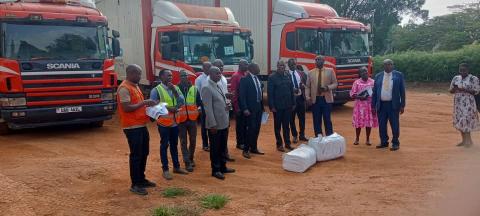
NAKASONGOLA FLAGS OFF 2,889 CARTONS OF MOSQUITO NETS TO COMBAT MALARIA
Nakasongola District has officially received and flagged off 2,889 cartons of long-lasting insecticide-treated mosquito nets from the Government of Uganda in a renewed effort to strengthen malaria prevention and protect communities against one of the country's leading public health challenges.
The mosquito nets, supplied through the National Medical Stores (NMS), will be distributed to households across all parishes in the district beginning next week. Under the distribution plan, each household will receive one mosquito net for every two family members.
While presenting the consignment to the district leadership, the Acting District Health Officer, Mr. Kirya Ronald, confirmed the receipt of the 2,889 cartons and said the distribution exercise forms part of the Government of Uganda's nationwide malaria prevention campaign aimed at reducing malaria-related illnesses and deaths.
Representing the Chief Administrative Officer, the Deputy Chief Administrative Officer, Mr. Kaggwa Daris, commended the Government of Uganda for its continued investment in improving public health through malaria control interventions.
He called upon Local Council I Chairpersons to ensure the mosquito nets are distributed fairly, transparently, and reach all eligible households. Mr. Kaggwa further urged residents to use the nets strictly for their intended purpose, warning against their misuse for activities such as fencing gardens, fishing, or constructing poultry shelters.
The District Chairperson, Mr. Semanda Rogers Kulaba, witnessed the flag-off of the consignment to the parishes and announced that household distribution will commence next week. He noted that the exercise is expected to benefit families across the district, with allocations based on household size to ensure equitable coverage.
Speaking during the ceremony, the Resident District Commissioner (RDC), Mr. Bandeeba Festus Besigye, officially flagged off the consignment to the parishes and applauded the Government of Uganda for prioritising the health of its citizens through sustained malaria prevention programmes.
The RDC encouraged residents to complement the government's efforts by sleeping under insecticide-treated mosquito nets every night, eliminating stagnant water around their homes, clearing bushes where mosquitoes breed, and maintaining proper sanitation to reduce mosquito breeding sites.
He also directed sub-county leaders to closely supervise the distribution exercise to ensure transparency, accountability, and equitable access to the mosquito nets throughout the district.
District leaders expressed confidence that the mass distribution campaign will significantly reduce malaria infections, lessen the burden on health facilities, and improve the overall health and well-being of communities across Nakasongola District.
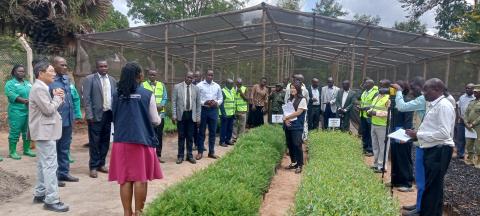
The Government of Japan, through Community Road Empowerment (CORE) has officially launched and handed over a major climate resilience and community infrastructure project to Nakasongola District, aimed at improving road connectivity, water harvesting, and environmental conservation.
The project was officially launched by His Excellency Takuya Sasayama, the Japanese Ambassador to Uganda, during a ceremony held at the District. The handover covered community access roads, water retention dams, and a tree nursery seedling bed, implemented under the CORE project in Nakitoma and Lwabyata Sub-Counties.
Speaking at the function, Nakasongola District Chairperson LCV, Rtd. Lt. Kigula Sam, described the district as one that is heavily affected by prolonged drought and environmental degradation. He emphasized that tree planting remains a key solution to regulating the environment and mitigating climate change impacts.
He commended CORE and the Government of Japan for their contribution toward environmental protection and climate adaptation in the district, noting that the District Council had designated 5th April every year as a District Tree Planting Day. However, he raised concern over termite destruction of trees and called upon communities to fully support the CORE project and embrace its interventions.
The CORE Project Engineer, Mr. Nuwagaba Bruce, revealed that the project, supported and funded by the Japanese Government, is currently being implemented in Lwabyata and Nakitoma Sub-Counties. He noted that CORE Uganda, an international Japanese non-governmental organization registered in 2018, operates in over five countries in Sub-Saharan Africa and focuses on environmental improvement, community road works, and livelihood enhancement.
Mr. Bruce disclosed that CORE has rehabilitated over 240 kilometers of community roads and trained local personnel who were organized into cooperatives to carry out spot road repairs at lower costs. He further explained that a water retention dam constructed in Nakitoma has helped improve water availability, though water retention remains challenged by the district’s harsh climatic conditions. An eight-member management committee has been formed to oversee the dam’s maintenance.
He also highlighted the establishment of a district tree nursery bed at Nakasongola District Headquarters, capable of producing over 100,000 quality seedlings, with projections to exceed 240,000 seedlings. Four personnel were trained to manage the nursery, and 45 indigenous tree species have been introduced. Nakasongola District was praised as the first district to cost-share in the project by providing water, nursery facilities, a water bowser for road construction, and payment for nursery attendants.
Addressing challenges, Mr. Bruce cited unpredictable rainfall patterns, which have affected planting seasons, and encouraged farmers to establish more water retention ponds. He assured the district of CORE’s continued collaboration with the local government.
The CORE Project Manager, Ms. Yuka Iwamura added that beyond roads and environmental conservation, the project also supports business community formation and energy-saving stove initiatives, working closely with the Ministry of Works. She explained that due to massive deforestation caused by charcoal burning and farming, establishing local nursery beds proved more cost-effective than outsourcing seedlings. She expressed gratitude to the Ministry of Foreign Affairs of Japan and the Japanese Government for funding the project and appreciated the Ambassador for presiding over the handover ceremony. She urged district leaders to replicate the initiative across other parts of Nakasongola.
In his remarks, Deputy Chief Administrative Officer, Mr. Kaggwa Daris, requested further support from the Japanese Government, citing the district’s need for improved road construction equipment, including a buckler and a tractor to help farmers transition from subsistence to commercial agriculture. He committed that the district would maintain the nursery bed, conduct regular radio sensitization programs, and ensure proper management of the dam to safeguard users.
The Resident District Commissioner, Mr. Bandeeba Festus Besigye, applauded the leadership of Nakitoma and Lwabyata Sub-Counties for embracing the project and thanked the Japanese Government for supporting Uganda’s development efforts. He credited Uganda’s peaceful environment, under the leadership of His Excellency President Yoweri Museveni for enabling international partnerships. He commended CORE for skill transfer to communities and pledged continued monitoring of the project to ensure sustainability.
In his keynote address, H.E. Takuya Sasamaya expressed immense satisfaction with the successful handover of the project, describing it as a strong demonstration of Japan’s commitment to supporting vulnerable communities. He acknowledged challenges faced by Nakasongola, including impassable roads during rainy seasons that hinder market access and school attendance.
The Ambassador revealed that over 260 kilometers of roads have been worked on using technology also applied in Japan during rainy conditions, and that the project has supported environmental sustainability through the production of over 900,000 tree seedlings. He commended Nakasongola District for setting an example in climate resilience and was encouraged by the involvement of schoolchildren in environmental conservation.
He reaffirmed that the project symbolizes the strong partnership between the Governments of Japan and Uganda, noting that Japan also faces climate challenges such as flooding. He announced plans to invite Japanese youth engineers to Nakasongola for benchmarking and knowledge exchange.
Overall, the successful launch and handover of the CORE project marks a significant milestone in Nakasongola District’s efforts to build climate resilience, improve rural infrastructure, and restore the environment. The initiative not only strengthens community road networks and water harvesting systems but also promotes sustainable environmental practices through large-scale tree planting and skills transfer. With firm commitments from the district leadership to maintain the facilities and sensitize communities, and continued goodwill from the Government of Japan and CORE, the project stands as a lasting symbol of effective international cooperation and a solid foundation for improved livelihoods and sustainable development in Nakasongola District.
Tuesday, February 10, 2026